








Key Signs It’s Time to Upgrade to a Ride-On Mower With Collector
At a Glance
Traditional mowing setups that separate cutting from debris collection create inefficiencies, repeated work and rising labour demands. Upgrading to ride-on mowers with integrated collection systems streamlines mowing operations, enabling single-pass cut-and-collect, improving productivity, reducing operator strain and maintaining consistent presentation across large or high-demand grounds.
Call us to discuss your ground maintenance requirements or arrange a suitable mower demonstration.
Why Standard Mowing Setups Struggle With Collection
Ground maintenance remains one of the most labour-intensive aspects of site upkeep across estates, gardens, campuses, and public spaces. From routine grass cutting to seasonal leaf clearance, these tasks require ongoing staffing and equipment, which typically account for a sizable portion of the operating budget. Even so, much time is spent on repetitive tasks such as leaf collection and debris removal, which becomes more noticeable as the seasons change.
Similarly, during spring and autumn, organic waste builds up quickly across larger sites. Leaves, grass clippings and debris accumulate faster than most teams can realistically manage within standard working hours. As a result, teams are forced to work harder, revisiting and re-cleaning the same areas multiple times. However, they still end up with inconsistent finishes and sites that never quite look fully maintained.
In many cases, the limitation is not the team, but the process itself. When cutting and collecting are handled separately, time is lost between tasks and efficiency drops. This is usually the point where ground managers prefer to upgrade to ride-on mowers that can handle both cutting and collection in a single pass.
The shift towards collector mowers is driven by the need to reduce manual handling and, eventually, to offer convenience and consistency. For facilities managers and grounds teams, the next step is choosing the right ride-on mower with a collector that can reliably support this change.
This is where working with specialist suppliers, such as Euromec, ensures access to proven equipment, backed by support and servicing. Nonetheless, if you are still doubtful and want to understand why this shift is necessary, it helps to look at how manual turf and debris collection is typically handled on-site.
Why Manual Turf and Debris Collection Doesn’t Work
On smaller sites, the process may appear manageable, with one team cutting the grass, another clearing debris, and collection occurring separately. As the size of the site grows, this approach slows everything down, not only because of lost time but also because of the faulty process of repetition.
The staff clears an area, the wind shifts, leaves fall again, and grass grows faster than anticipated. The same space requires attention twice, if not three times, throughout the day. The staff must repeatedly lift, bend, and walk across large areas, which causes physical strain.
This eventually creates slower teams with low productivity, prompting mower upgrades rather than adding more labour to the task.
4 Key Signs You Should Upgrade Your Turf Maintenance Approach
1. Increasing Time Spent Clearing The Same Area
It is not just the frequency that increases, but also the unpredictability. Teams may clear an area in the morning, only to return by the afternoon because of further buildup. This disrupts planned schedules and pushes other maintenance tasks further down the list. Over time, this creates a reactive cycle in which teams are constantly catching up rather than maintaining. A ride-on mower with a collector helps break that cycle by completing the job in one pass and handling both cutting and collection.
2. Multiple Operatives Required For Routine Grounds Maintenance
As the workload increases, tasks that were previously handled by one operator now require two or three people. Not because the work has changed, but because the procedure has become inefficient. This also leads to underutilised labour, as one team member may wait for another to finish clearing before proceeding with collection, resulting in productivity gaps.
This is where mower upgrades improve performance while also simplifying teamwork. A single-operator system reduces overlap and allows employees to be redeployed to higher-value tasks throughout the facility.
3. Difficulty Keeping Sites Well Presented During Peak Seasons
During peak growth or heavy leaf fall, consistency becomes harder to maintain. Even well-managed teams struggle to maintain the same standard across all areas, and this is where presentation starts to slip in visible ways.
Edges look untidy, surfaces appear uneven, and debris remains in high-traffic areas longer than expected. However, choosing the best ride-on lawn mower with a collector from our range at Euromec can help support teams achieve a more uniform finish.
4. Rising Labour or Contractor Costs
Labour costs rarely increase in isolation and are mainly linked to inefficiencies in how work is carried out. Seasonal contractor support can help manage peaks, but it introduces additional coordination, cost variability, added rental terms and dependence on external availability.
As time goes on, this becomes difficult to manage within fixed budgets. Investing in a ride-on mower shifts that balance and brings more of the work in-house. It also improves cost predictability and reduces reliance on temporary solutions that do not address underlying inefficiency.
How Collector Mowers Change the Workflow
By this stage, the issue is not whether the current process works but how much time it continues to take.
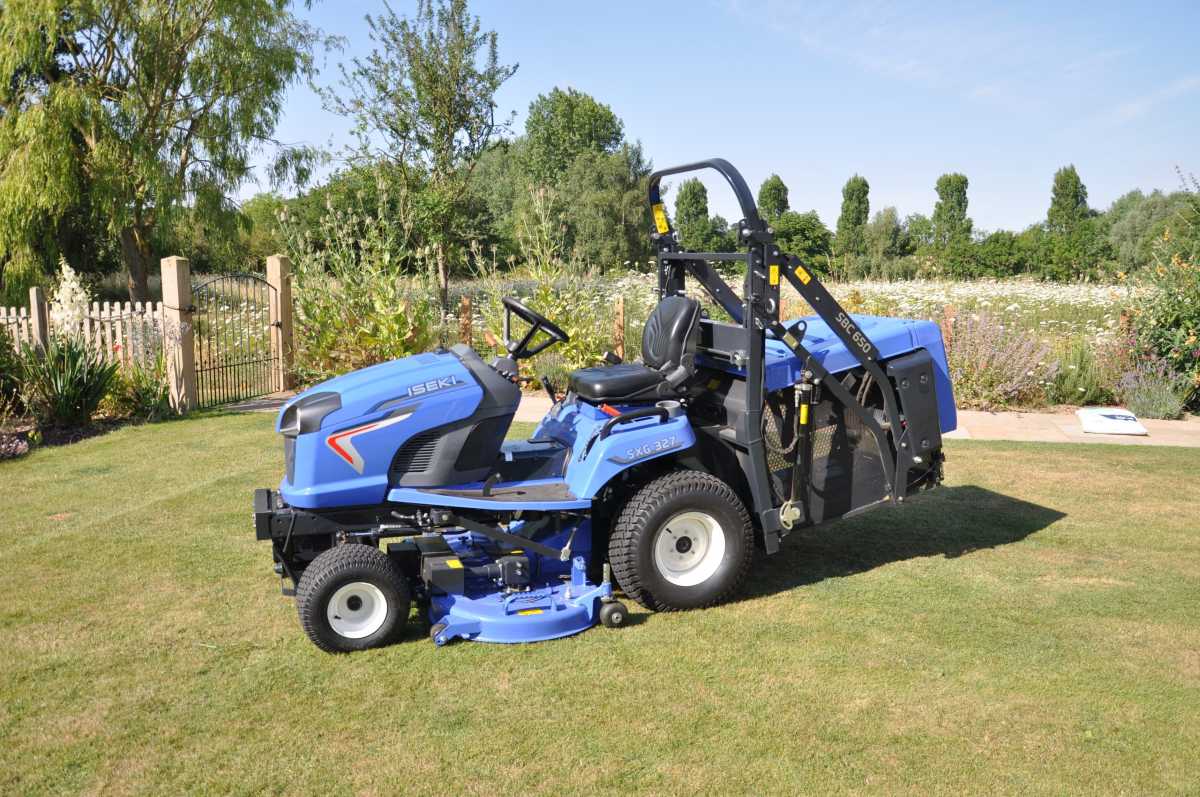
A ride-on mower simplifies the workflow by combining cutting and collection into a single pass. Machines such as the Iseki SXG Series are designed with high-capacity collection systems, offering up to 650 litres of debris capacity, allowing operators to cover larger areas without frequent stops.
A single operator can complete a section fully before moving on, without leaving debris behind or relying on follow-up clearing. With cutting widths exceeding 1 metre, it is suited to large open spaces. This removes repeat visits, reduces reliance among team members and makes work easier to schedule, even during peak periods.
With machines taking on more of the workload, reliability becomes critical. This is where Euromec supports operations beyond supply. With a portfolio that includes dedicated collector mowers, such as the Iseki SXG range, alongside a wider range of groundcare and industrial cleaning equipment, we provide machines suited to real working conditions, with parts availability and support.
Where The Iseki SXG Range Fits In
For many grounds teams, this transition leads to purpose-built solutions supplied by Euromec, and the Iseki SXG Series designed specifically for high-efficiency cut and collection across larger sites, is one of them. Let’s understand how it works:
Purpose-Built Collector Design
The SXG range is built to cut and collect, offering a direct flow system that moves grass and debris from the deck to the hopper without obstruction. This helps maintain consistent performance even in wet or heavy conditions. With cutting widths ranging from 40 to 54 inches and engines between 13.5 hp and 21.6 hp, the machine is designed to cover ground quickly while maintaining a clean finish.
High-Capacity Collection System
One of the biggest workflow advantages comes from capacity. This range offers collectors up to 650 litres, with a hydraulic high-tip system that can empty directly into trailers or designated collection points. This reduces the frequency of stops and removes the need for manual unloading, which is where time is lost during peak seasons.
Suitable For Larger Commercial Sites
The SXG range is designed for large, open environments where consistency is crucial. Its ability to cut and collect effectively in both wet and dry conditions allows teams to continue working without weather-related delays.
For comparison, machines such as the Iseki SF5 Series are better suited to areas requiring precision and stability, particularly around obstacles or landscape features.
Similarly articulated models, such as the STIGA Park Pro 4WD and STIGA Park 4WD, are built for manoeuvrability on uneven terrain. The SXG range, however, is built for volume, and when the priority is to collect large amounts of debris effectively and achieve a consistent finish in one pass, it fits the requirement directly.
Comparing Iseki SXG to Traditional Leaf Collection
| Factors | Iseki SXG | Manual Collection |
| Time per hectare | Wide cutting decks (40 to 54 inches) enable simple pass-cut-and-collect, reducing time per hectare | Separating teams to cut, clear and collect in different stages increases the time taken per hectare |
| Operator fatigue | Less fatigue because of hydrostatic drive, seated operations and ergonomic controls | Higher fatigue as workers need to walk, lift, clean, pick and handle debris repeatedly |
| Collection efficiency | Maintains performance in wet and heavy conditions due to direct chute design and airflow control | Drops significantly in wet and rainy seasons, requiring repeat passes or even stalled activities |
| Collection capacity | Up to 650 litres with hydraulic high-tip discharge, reducing emptying frequency | Limited by manual tools and containers, requiring frequent stops |
| Working continuity | Extended run time supported by a 21-litre fuel tank and efficient diesel engines up to 21.6hp | Extremely interrupted because of disposal trips and team coordination. |
The need to upgrade ride on mower systems becomes more apparent when the existing methods start to affect how work is planned and finished. This especially applies when tasks begin to carry over and teams spend more time managing the process than finishing it. At this point, upgrading to a ride-on mower with a collector helps bring structure back into daily operations by completing each area in a single pass.
Make The Right Mower Upgrades at The Right Time with Euromec
Choosing the right machines depends on how your site is maintained day to day. For high-volume cut-and-collect, the Iseki SXG Series is built for consistent performance over larger areas. Where visibility and precision are important, the Iseki SF5 Series offers a high-tip collector system and a larger-capacity option suited to demanding commercial use, including collectors up to 1300 litres.
For tighter spaces or sites that require a more compact solution, the Iseki SF2 Series provides manoeuvrability without compromise on finish.
On varied or uneven terrain, you may also try the machines, such as the STIGA Park Pro 4WD and STIGA Park 4WD, which offer greater control and traction. For smaller or less demanding areas, the STIGA Park 2WD can be a great alternative.
All of these sit within Euromec’s wide range of professional groundcare equipment, supported by nationwide delivery, aftersales service and parts availability to keep machines working throughout the seasons.Call or email Euromec to request a tailored quote or arrange a demo.

Nikki
Director
Nicola has worked in the cleaning machine industry for 18 years across both Sales and Service. Nicola has an comprehensive knowledge of a range of cleaning machine makes and models, and has been instrumental in the sale and servicing of machines across a vast range of applications.